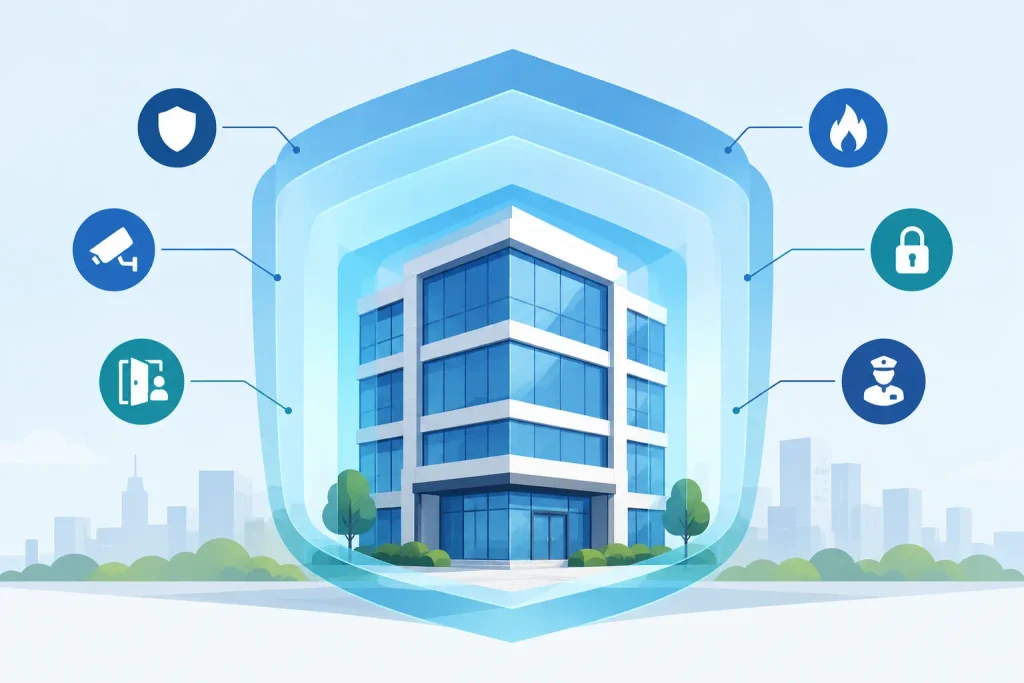
A locked front door is not a security program. It is one control in a larger system that must protect people before, during, and after a threat. What makes a building secure is the way its physical protections, daily procedures, trained personnel, and response plans work together under real conditions.
For a business, school, church, medical facility, or government office, the goal is not to make a property feel like a fortress. The goal is to reduce opportunities for unauthorized access, identify concerns early, give staff clear responsibilities, and improve the odds of a coordinated response when pressure is high. Security must support the organization’s mission while providing meaningful protection for everyone inside.
What Makes a Building Secure in Practice?
A secure building uses layers. If one layer fails or is bypassed, another should slow the person down, alert staff, limit access, or support a response. This is often called layered security, but it is more useful to think of it as a sequence of practical decisions: Who should enter? Where should they go? What should staff notice? How will the organization act if something is wrong?
No two facilities need the same controls. A daycare center, warehouse, outpatient clinic, and house of worship face different operational needs and public access expectations. Effective security is based on a site-specific assessment of the property, the people who use it, the services delivered there, and credible risks. Adding equipment without that assessment can create cost and inconvenience without solving the actual problem.
Controlled access starts at the property line
Security begins before someone reaches the front door. Parking areas, walkways, landscaping, exterior lighting, signage, gates, and delivery zones all influence how easily a visitor can approach and move through a property.
Clear wayfinding directs legitimate visitors to the appropriate entrance rather than allowing them to wander around the building. Good lighting supports natural observation and camera coverage, particularly around entrances, parking areas, and paths used early in the morning or after dark. Landscaping should be maintained so it does not create concealed areas near doors, windows, or walkways.
Exterior measures do not need to be intrusive. Their purpose is to make expected routes obvious, discourage unauthorized entry, and help staff or visitors recognize activity that does not belong. A loading entrance left propped open for convenience, for example, may create more exposure than a carefully selected security device can offset.
Doors, locks, and credentials must support daily operations
Most unauthorized access happens through ordinary openings: a front entrance during a busy period, an employee entrance, a side door, or a door held open by someone trying to be helpful. Secure facilities establish which entrances are public, which are employee-only, and when each door should be open, locked, monitored, or alarmed.
Access control can range from quality mechanical locks and key control to electronic credentials, video intercoms, and visitor management systems. The appropriate level depends on the facility. Electronic access systems can provide useful records and allow credentials to be removed quickly when an employee leaves, but they still require sound policies. Sharing badges, failing to retrieve keys, and ignoring door alarms can undermine the system.
Door hardware matters as well. Exterior doors should latch and lock reliably, frames should be properly maintained, and staff should know when a malfunction must be reported. In areas where people may need to shelter during a violent critical incident, the ability to secure a room from the inside can be a significant protective factor. Any changes must remain consistent with fire and life-safety requirements.
Security depends on people, not equipment alone
Cameras, alarms, and access systems provide value, but they do not make decisions. People do. Employees, volunteers, supervisors, reception staff, and contractors need to understand their role in maintaining a secure environment.
That starts with simple expectations: do not prop secured doors open, challenge access concerns through established procedures, report suspicious behavior promptly, and protect keys, badges, and sensitive information. These habits are not minor details. They are the daily actions that preserve the value of every physical control.
Training should also address behavioral threat awareness. The focus is not on labeling people based on appearance or making staff fearful of every unusual interaction. It is on recognizing concerning behaviors, communications, fixation, escalating grievances, or efforts to test security boundaries, then reporting those concerns through a defined process. Early reporting gives leadership the opportunity to assess facts, document concerns, and involve appropriate resources when needed.
Reception and visitor procedures set the tone
The front desk is often the building’s first decision point. Staff need a process that is professional, repeatable, and appropriate for the setting. Visitors may be asked to sign in, wear identification, state their destination, or wait for an escort. In some organizations, a receptionist can confirm appointments and control access through a locked interior door. In others, a monitored lobby and clear staff presence may be more practical.
The right procedure balances hospitality with accountability. A church welcoming new families, for example, should not operate like a restricted government facility. Yet it can still designate entry points, secure children’s areas, train greeters to report concerns, and maintain a plan for disruptive or threatening behavior. Security works best when it fits the organization rather than being copied from a different environment.
Cameras and alarms need an operational purpose
A camera system is useful only when it captures the right areas, produces usable images, and is supported by a plan for review and response. Cameras should cover priority entrances, public-facing reception areas, cash-handling locations, critical corridors, and exterior areas identified during the assessment. Camera placement should account for lighting, obstructions, image quality, recording retention, and who can access footage.
More cameras are not always better. A camera pointed at an area with poor lighting or an angle that cannot identify a person may offer false confidence. Similarly, footage reviewed only after an incident has limited preventive value. Some facilities benefit from live monitoring, while others need reliable recording, clear retention policies, and an established process for preserving footage after a report.
Alarm and notification systems must also be understood by the people expected to use them. Staff should know what a door alarm, panic alarm, fire alarm, lockdown notification, or mass communication message means and what action follows. An alert without a practiced response can create confusion at the moment clarity is most needed.
Plans must account for stress and decision-making
A written emergency plan is necessary, but a binder on a shelf does not prepare people to act during a critical incident. Stress can narrow attention, distort time perception, interfere with communication, and make even familiar choices difficult. Preparedness training should recognize that reality.
Staff need practical options based on their location, the information available, and the immediate threat. They should understand how to communicate an emergency, when to move away from danger, how to secure a space when evacuation is not safe, and how to assist others without creating additional risk. Training should be tailored to the workplace, not delivered as a generic presentation detached from the facility’s layout and responsibilities.
Exercises and drills should be purposeful. A brief tabletop discussion may reveal that managers do not have current contact information, employees are unclear about who calls 911, or a designated shelter area cannot be secured. A walkthrough can identify blocked exits, confusing signage, or communication gaps. These are valuable findings because they can be corrected before an emergency forces the issue.
Assessments turn assumptions into actionable improvements
Organizations often know where they feel vulnerable, but feelings are not the same as a documented security analysis. A physical security assessment examines the facility from the outside in, reviewing access points, locks, doors, cameras, lighting, visitor procedures, emergency planning, staff practices, and site-specific concerns.
The strongest assessments do more than identify problems. They prioritize recommendations according to risk, operational impact, and available resources. Some improvements may be low-cost and immediate, such as repairing a door closer, updating key records, removing visual obstructions, or clarifying visitor procedures. Others may require capital planning, including access control upgrades, improved camera coverage, or redesigned entry points.
This prioritization matters. Not every organization can make every improvement at once, and not every vulnerability has the same consequence. A practical plan identifies the measures that will most improve safety without disrupting the organization’s ability to serve its people. Oracle Security Consultants approaches assessments and training as connected work: the building, the policies, and the people using them must support one another.
Security is maintained, not installed
A building can become less secure without any major change. Employee turnover can leave unreturned keys and outdated access credentials. Construction can create temporary openings. A camera can fail unnoticed. A new program may bring more visitors through an entrance that was never designed to manage them.
Leadership should review security after operational changes, significant incidents, facility modifications, or changes in local threat conditions. Regular checks of doors, lighting, cameras, access permissions, emergency contacts, and staff procedures help prevent small gaps from becoming routine vulnerabilities.
The most secure building is not the one with the most visible hardware. It is the one where leadership has made deliberate choices, staff understand their responsibilities, and protective measures are tested against the way the facility actually operates. That steady commitment gives people something more valuable than the appearance of safety: a credible plan for protection.