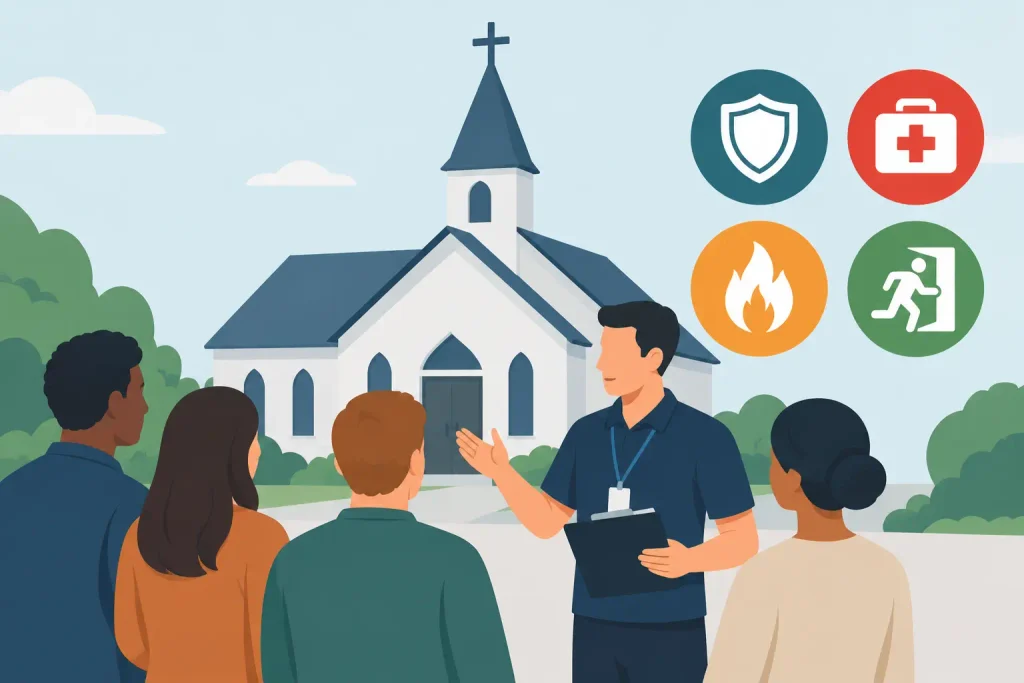
A Sunday service can bring hundreds of people through several entrances, with children moving between classrooms, volunteers greeting guests, and staff focused on ministry rather than security. That is why a church safety training case study should begin with the realities leaders manage every week, not with a generic emergency checklist.
The following composite case study reflects common challenges seen in church preparedness work. Details have been generalized to protect privacy, but the decisions, gaps, and training outcomes are directly relevant to churches seeking a practical path toward stronger safety.
The Church Had Good People but No Shared Response Plan
The church in this case was an active, mid-sized congregation with a weekday preschool program, multiple Sunday services, youth activities, and frequent community events. Its leaders cared deeply about member and visitor safety. Several volunteers had law enforcement, medical, or military backgrounds, and the church had a small safety team present on Sundays.
Yet the leadership team recognized an uncomfortable issue: safety knowledge was concentrated in a few people. Ushers, children’s ministry volunteers, office staff, worship team members, and ministry leaders did not share the same understanding of what to do if a violent critical incident occurred.
The church had written emergency procedures, but they had not been discussed consistently. Some volunteers believed they should immediately locate a safety team member. Others assumed they were responsible for directing people outside. A few thought everyone should shelter in place regardless of where the threat was located. These are understandable assumptions, but conflicting assumptions create hesitation when seconds matter.
The goal was not to turn ministry volunteers into security professionals. The goal was to give every responsible adult a clear, realistic framework for recognizing danger, making sound decisions under stress, communicating what they knew, and protecting those in their immediate care.
What the Initial Review Revealed
Before training, church leaders reviewed the building’s routines and physical environment. The discussion quickly moved beyond the main sanctuary. A preparedness plan that only addresses the worship space overlooks the nursery hallway, classrooms, parking areas, church office, fellowship hall, and exterior gathering areas.
Several concerns emerged. The church had multiple entry points, but the level of monitoring varied by service and event. Some doors that were intended to remain secured were occasionally propped open for convenience. The children’s ministry check-in process was thoughtful, but classroom volunteers had not received consistent direction on lockdown, evacuation, or parent reunification during an emergency.
Communication was another concern. The safety team used radios, but most staff and volunteers did not know what language would be used to report a threat or how leadership would communicate instructions to the rest of the facility. The church also had no established process for quickly confirming which rooms were occupied during a weekday program.
None of these findings meant the church was careless. They reflected a common reality: churches are welcoming environments with changing schedules, rotating volunteers, and facilities designed for ministry rather than controlled access. A plan must account for that reality rather than pretend the church operates like a corporate office or law enforcement facility.
Church Safety Training Case Study: Building Decision-Making Skills
The training was designed around one central principle: people do not respond to stress exactly as they respond during a calm meeting. Under a violent threat, perception can narrow, hearing can change, memory can become incomplete, and familiar tasks can suddenly feel difficult.
For that reason, the session did not rely on a simple instruction to “be aware.” Participants learned why stress affects judgment and how to work through it. They practiced identifying relevant information: where the threat is located, whether there is a safe path away from it, who is immediately under their care, and what can be communicated to others without spreading confusion.
The instructor used realistic church-specific examples. A children’s volunteer may need to make a different decision than an usher near an exterior exit. A staff member in the office may have useful information to relay to 911 and responding officers. A worship leader on stage may need to follow established direction rather than improvise over a public-address system.
This was a key change in the church’s approach. Training was not presented as a script that would fit every scenario. It gave people principles for making the best available decision with incomplete information.
Participants also discussed the difference between an uncomfortable interaction and behavior that warrants immediate action. Churches want to welcome people respectfully, including individuals who may be distressed, disruptive, or unfamiliar to the congregation. At the same time, volunteers need permission to report concerning behavior early. Behavioral threat awareness is not about judging someone by appearance. It is about noticing actions, statements, access attempts, escalating agitation, and other observable indicators that require attention.
Defining Roles Without Creating Confusion
The church left the training with clearer role boundaries. The safety team was responsible for observing, assessing, communicating, and coordinating with law enforcement. Ministry volunteers were responsible for the people and spaces assigned to them. Senior leaders were responsible for decisions that affected the congregation broadly, including family communication and continuity after an incident.
That distinction mattered because an unclear role often produces two opposite problems. Some people take actions outside their training or authority. Others do nothing because they assume someone else is handling it.
The revised plan established straightforward expectations for four groups:
- Safety team members would monitor designated areas, communicate verified information, and coordinate emergency response.
- Children’s ministry volunteers would secure or evacuate rooms based on the location of the threat and the safest available option.
- Ushers and greeters would report concerns promptly, maintain awareness of entrances, and help guide people when conditions allowed.
- Staff and ministry leaders would support accountability, emergency communications, and reunification procedures.
Not every church needs the same structure. A single-building congregation with one weekly service has different needs than a large campus with a school, multiple worship venues, and daily traffic. The value of training is in defining responsibilities that fit the actual operation of the church.
The Facility Changes Were Practical, Not Performative
Training revealed that procedures alone were not enough. People cannot follow a clear response plan if door hardware, room visibility, communication tools, or access practices work against them.
The church prioritized a manageable set of improvements. It clarified which exterior doors would remain secured during services, assigned ownership for door checks, improved visibility in a poorly lit exterior area, and established a consistent method for identifying authorized children’s ministry access. It also reviewed camera coverage and confirmed that emergency information was readily available for responding law enforcement.
Leaders resisted the temptation to buy equipment simply because it appeared impressive. Cameras, radios, locks, and access-control systems can support preparedness, but they are not substitutes for trained people and workable procedures. A camera that does not cover a critical approach, a radio channel nobody monitors, or a locked door that impedes safe egress can create a false sense of security.
The strongest changes connected people, process, and facility design. Volunteers knew what the physical measures were intended to accomplish and how to work within them.
What Changed After the Training
The most meaningful outcome was not that every participant could repeat a policy word for word. It was that leaders and volunteers had a shared language for safety.
Staff became more comfortable reporting concerns before they escalated. Children’s ministry leaders understood that parent reunification must be planned in advance, not invented while families are frightened. The safety team had a clearer process for communicating with church leadership and first responders. Senior leaders also recognized that periodic practice was necessary because volunteer turnover can quietly weaken even a well-designed plan.
The church scheduled shorter follow-up sessions for new volunteers and leadership teams rather than treating safety as a one-time event. It also built safety discussions into event planning, especially for large services, holiday programs, and activities that brought unfamiliar visitors onto campus.
Preparedness did not make the church less welcoming. In practice, it allowed ministry teams to be more confident in their hospitality because they understood how to respond when something did not seem right.
The Lesson for Church Leaders
A church safety program should not be built around fear or a promise that every threat can be prevented. It should be built around responsibility: protecting people, reducing preventable vulnerabilities, and preparing adults to make informed decisions during an emergency.
For some churches, the first need is active shooter preparedness training. For others, a physical security assessment may reveal that access control, communication, lighting, or emergency procedures require attention first. Often, both are necessary. Oracle Security Consultants helps organizations connect these pieces through practical instruction and facility-specific recommendations.
The next useful step is not to wait for a perfect plan. Gather the leaders responsible for worship, children, facilities, operations, and volunteer coordination. Walk the property together, identify where decisions would be difficult, and begin building the shared readiness your congregation deserves.